The agenda included:
- Identification of relevant fields of application and competence profiles
- Promotion of international scientific cooperation
- Networking of research institutions with industry partners
More than 80 international guests accepted TUM's invitation. Professor Ali Sunyaev, Vice President of TUM Campus Heilbronn, welcomed the participants and emphasized: “This forum is based on cooperation: scientific dialogue, practical insights and new networks pave the way for sustainable innovation.”
The ‘Joint Global AI Research Hub’ was created based on this fundamental idea. It consists of ETH Zurich, Hebrew University of Jerusalem (HUJI), HEC Paris, Nanyang Technological University (NTU), National University of Singapore (NUS), Stanford University, University of Oxford and TUM Campus Heilbronn. Ali Sunyaev called for the four days to be used for intensive professional exchange and new approaches to cooperation.
Discussion on the Future of AI
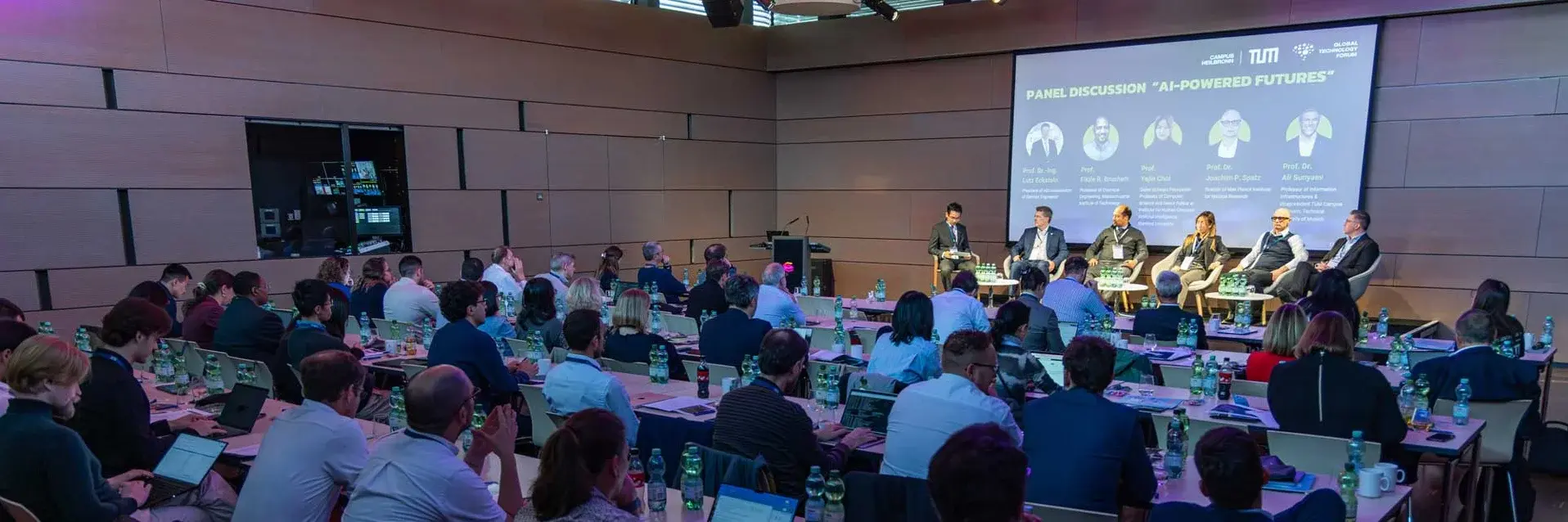
In a panel moderated by Professor Jingui Xie, Professor of Business Analytics at TUM Campus Heilbronn, participants discussed what an ideal AI-driven future might look like. The business community was represented by VDI President Lutz Eckstein, who emphasized the importance of explainable AI and the integration of AI-related learning content. Professor Yejin Choi (Stanford University) pointed out the relevance of small, efficient models for sustainable AI use.
For keynote speaker Professor Joachim Spatz from the Max Planck Institute for Medical Research, this also requires the sustainable use of AI: reducing energy consumption is essential for him. Fikile Brushett (MIT), who was awarded the Dieter Schwarz Courageous Research Grant at the Global Technology Forum, also pointed out the importance of interdisciplinary perspectives.
In workshops on the topics of ‘AI in education’ and ‘AI in healthcare,’ participants discussed potential areas of application and research approaches. The program was complemented by exchanges with regional partners from industry and small and medium-sized enterprises.
Promoting Interdisciplinary Collaboration
On the second morning, the partners of the Joint Global Research AI Hub discussed possible research approaches that go beyond the current horizon and promote interdisciplinary collaboration in internal workshops. Examples of applications were then presented at the Artificial Intelligence Innovation Park (IPAI). Afterwards, the group moved from the laboratory to the factory at Schunk in Brackenheim-Hausen to bring together cutting-edge research and regional SMEs.
The detailed report on the company visit is available here.
As usual at the Global Technology Forum (GTF), the insights on Friday morning were followed by outlooks in the form of various workshops. The common thread was two follow-up sessions on the topic of ‘AI in Education’ by and with TUM Professor Stefan Wagner. The ‘Human-AI Interaction’ workshop was led by Dr Keja Hu from Oxford, while Dr Fabian Stephany, also from the Oxford Internet Institute, addressed the pressing topic of ‘AI in Work’.
Questions About Human-AI Interaction
In the area of human-AI interaction, Keja Hu (Oxford) emphasized that the workshop opened up starting points for joint research and new ideas for scientific publications, focusing on topics such as system design, understanding roles and the orchestration of humans and machines. In ‘AI in Work,’ Fabian Stephany showed that the proportion of jobs requiring AI skills has tripled in the last ten years, further increasing the relevance of such skills.
Under the heading ‘AI in Education,’ all three sessions discussed key questions about which core skills still need to be taught and how teaching can be meaningfully designed with AI, including topics such as personalized learning, teacher training, social challenges, dealing with AI-generated content, and issues of equal opportunity and access. The next step is to coordinate a series of workshops at Stanford University.
Strengthening the Scientific Network
The GTF highlights Heilbronn's role as an up-and-coming technology ecosystem. Professor Ali Sunyaev describes the forum as a think tank that brings together top minds in tech development, emphasizing that the results achieved form the basis for further collaboration.
International guests such as Guy Harpaz (Hebrew University), Andrea Masini (HEC Paris) and Vicki Nash (Oxford Internet Institute) highlighted the region's clear research agenda and strategic approach. The Dieter Schwarz Foundation and the ‘Bildungscampus’, which is constantly attracting new research institutions – from Fraunhofer to ETH Zurich to the Max Planck Society and imec – play a central role in this. For the guests, Heilbronn is a location that stands out for its continuous investment in research and innovation.